What Exactly Is a SOC 2 Compliance Audit (and Why It Matters Now)
Let’s clear up the single biggest misconception first: SOC 2 is not a certification. You don’t get a badge you hang on your wall like ISO 27001. It’s an attestation report — a CPA firm’s professional opinion on whether your controls are designed and operating effectively.
Type 1 vs. Type 2: The one that actually matters
There are two flavors, and your prospects will almost always demand the second:
- Type 1: A snapshot. The auditor checks if your controls are designed properly at a single point in time. Useful for a quick “we’re working on it” signal, but it doesn’t prove you follow them day-to-day.
- Type 2: The real deal. The auditor watches your controls operate over a period — typically 6–12 months — and issues an opinion on whether they were effective the whole time. Over 90% of enterprise procurement teams require a Type 2 report before signing a contract.
The five Trust Services Criteria (but really, just one)
SOC 2 is built around five criteria: Security, Availability, Processing Integrity, Confidentiality, and Privacy. In practice, nearly every startup starts — and often stops — with Security (the “common criteria” covering access controls, monitoring, and incident response). The other four are additive. If you’re trying to unblock that lost deal, Security is your minimum viable scope.
Why your prospect won’t take “we’re secure” on faith
That security questionnaire you just got? It’s a symptom. Large vendors have been burned by breaches at smaller partners — vendor-related data incidents cost businesses an average of $1.2–$2.4 million per event. They need a third-party auditor to verify your controls, not your word. A clean SOC 2 Type 2 report is the fastest way to turn that lost deal into a signed contract.
Do You Actually Need a SOC 2 Audit? (A Decision Framework for Lean Teams)
Before you block off engineering sprints and start budgeting five figures for an auditor, let’s be honest: not every startup needs a SOC 2 audit right now. The decision usually comes down to one of three triggers: a prospect contract clause that explicitly requires it, a brutal security questionnaire from a Fortune 500 buyer, or a board mandate because your sales team keeps losing deals. If none of those apply, you might be buying a solution to a problem you don’t have.
Here’s the quick framework. If a single enterprise prospect is demanding SOC 2 to close a deal, a Type 1 report (a point-in-time snapshot) can often get you over the line in 4–6 weeks and cost roughly $15,000–$30,000. It’s a tactical Band-Aid. But if your customer base or pipeline is full of organizations that require ongoing assurance — think financial services, healthcare — you’ll need a Type 2 report, which requires your controls to operate for a minimum of 3–6 months before the auditor starts testing. That’s a $40,000–$80,000 commitment and a 6–9 month journey.
For smaller deals or early-stage prospects, consider whether a lighter alternative buys you time. A completed SIG (Standardized Information Gathering) questionnaire or a CAIQ (Consensus Assessments Initiative Questionnaire) can satisfy many mid-market security reviews without the audit overhead. Startups that proactively publish a custom security packet — covering encryption, access controls, and incident response — close 30% more deals with sub-enterprise buyers than those who wait for a formal report.
The rule of thumb: If you have a Fortune 500 customer, handle sensitive personal data (PII, PHI, or financial records), or sell to regulated industries, you need SOC 2. Period. If you’re selling to SMBs or early-stage startups, a strong security packet and a signed NDA might be all you need until your revenue justifies the audit cost.
Realistic Timeline: From Zero to SOC 2 Type 2 Opinion
Let me save you the sales pitch and give you the honest math: a first-time SOC 2 Type 2 audit takes 6 to 10 months from start to signed report. If your board or sales team thinks you can do it in eight weeks, reset those expectations now.
The timeline breaks into three distinct phases, and the middle one is where most startups get stuck:
- Readiness / gap assessment (4–6 weeks): You or a third party maps your current security practices against the Trust Services Criteria. This is where you discover that your “incident response process” is a Slack channel and a prayer. 43% of first-time SOC 2 candidates discover at least two critical gaps during this phase that require new tooling or process changes.
- Control implementation (4–8 weeks): You build what’s missing — access reviews, change management procedures, vendor due diligence, monitoring alerts. Engineering is not blocked during this period, but they will be annoyed. The key is to lean on existing tools (your cloud provider’s native logging, your ticketing system) instead of buying a compliance platform on day one.
- Control operating period (3–6 months minimum): This is the non-negotiable clock. Your controls must run for at least three consecutive months — six is safer — before your auditor can test them. You cannot skip this. If you start the operating period in January, your auditor isn’t walking in the door until April at the earliest.
Total elapsed time: 6–10 months for a Type 2 opinion. A Type 1 audit can be done in 2–3 months, but it only buys you a checkbox, not customer trust. Most enterprises who demand SOC 2 want Type 2 — and they’ll ask when your operating period started before they schedule a call.
How to Prepare Without Over-Investing in Tools or Headcount
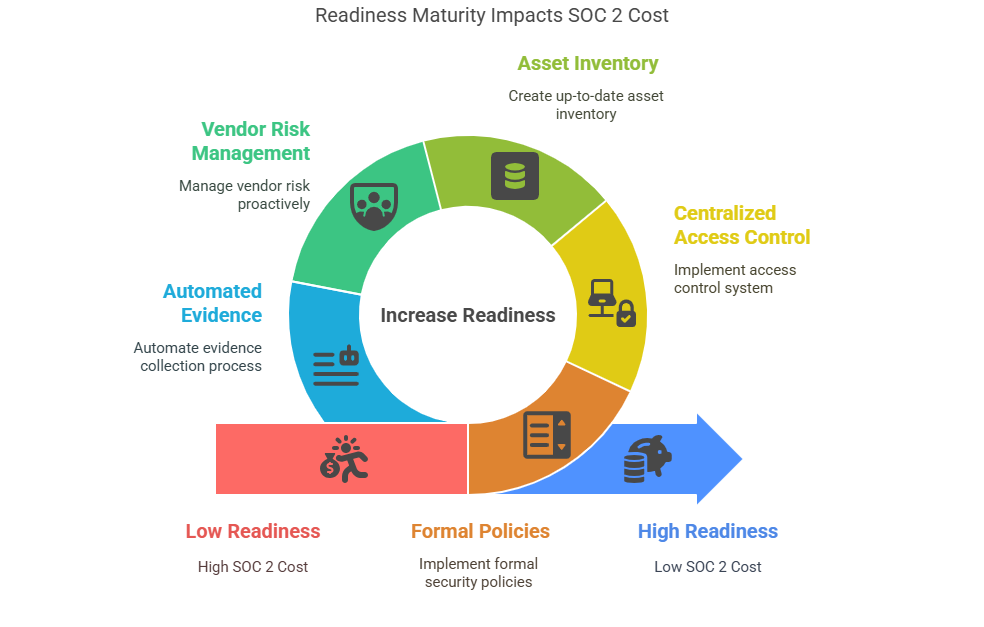
Before you green-light a five-figure compliance platform or post a job for a full-time security hire, pump the brakes. The median annual wage for an information security analyst is over $120,000 — a massive line item for a startup that might only need compliance support for six months. You can get through your first SOC 2 Type II audit without either.
Start with a shared drive (Google Drive, Notion, or even a folder on your NAS) and a master spreadsheet. That spreadsheet is your evidence map: one row per control, columns for the policy that governs it, the evidence artifact you’ll produce, and the tool where that artifact lives. That’s it. You don’t need a compliance platform until you’re managing multiple frameworks or renewals.
Next, audit the tools you already pay for. Your Google Workspace admin console generates audit logs for user access and data sharing. AWS CloudTrail tracks infrastructure changes. Slack channels can serve as your incident communication log. Most SOC 2 controls don’t require a dedicated security tool — they require proof that you’re doing the thing you claim to do.
The one hire you should consider: a fractional virtual CISO or part-time compliance consultant. Expect to pay $150–$300/hour for 10–20 hours per month during prep. That’s a fraction of a full-time salary, and they’ll bring policy templates, control mappings, and auditor relationships you don’t have.
Free resources to grab today:
- NIST CSF mappings — available on NIST’s site; map your controls to the Trust Services Criteria for free.
- Open-source policy templates — check the SANS InfoSec Policy Templates or the CIS Benchmarks community.
- Community SOC 2 playbooks — repos on GitHub and the Security Careers Slack community have battle-tested evidence lists.
Your goal isn’t perfection on day one. It’s defensible evidence that proves you’re doing what you say. A spreadsheet and a part-time consultant can get you there for under $10,000 in prep costs — not the $50,000+ tooling stack your sales team might be imagining.
Mapping Your Existing Security Practices to the Trust Services Criteria
You’ve got MFA, a password manager, and you do code reviews. Good news: that’s not nothing. Those three practices alone cover roughly 30–40% of the Common Criteria for the Security trust service. The trick is learning to map what you already do to the criteria’s formal language — and spotting the gaps that trip up most startups.
Here’s the honest framework: don’t try to build a fortress. Auditors want reasonable controls, not perfection. Use a simple red/yellow/green scoring system for each criterion:
- Green: You have a documented process and evidence it’s followed (e.g., MFA is enforced, logs exist).
- Yellow: You do it informally but lack documentation or consistency (e.g., “we review incidents in Slack but have no formal incident response plan”).
- Red: You don’t do it at all.
Most startups score green on logical access (MFA, password managers) and change management (code reviews, feature flags). The red zones that kill Type 2 audits? Vendor risk management — you’re using AWS, Stripe, and Datadog but have no formal review of their SOC 2 reports. Incident response plans — you handle outages ad hoc but can’t show a documented, tested runbook. Annual security training — you sent one email about phishing last year. And data retention policies — you keep everything forever because deleting scares you.
Your goal: turn every red to yellow, and every yellow to green before the auditor starts counting the clock on your observation period. You don’t need a compliance officer to do this — a spreadsheet and a shared drive with dated policies will get you 80% of the way there.
How to Choose and Vet a CPA Firm for Your SOC 2 Audit
Choosing a CPA firm for your SOC 2 audit feels a lot like hiring a referee for a game you’re not sure you’ve practiced enough for. Get the wrong one, and you’re out thousands of dollars with a report that kills deals instead of closing them. Here’s the hard truth upfront: only a licensed CPA firm can legally issue a SOC 2 report. That boutique “compliance shop” that promises a quick pass? They can help you prepare, but they cannot sign the opinion.
Start your search by asking founders at similar-stage SaaS startups who they used. Nearly 40% of first-time SOC 2 candidates underestimated the auditor’s role in scoping — leading to scope creep and surprise costs. Avoid that by scheduling free scoping calls with 2–3 firms before signing anything. During those calls, watch for these red flags:
- A promise of a clean report upfront. No ethical auditor can guarantee a pass before seeing your controls operate for the full observation period.
- A flat fee quoted before understanding your environment. If they’re not asking about your number of systems, subservice providers, or customer data types, they’re pricing blind — and you’ll pay for it in change orders later.
- No SaaS clients in their portfolio. SOC 2 for a data center is different from SOC 2 for a multi-tenant SaaS platform. Ask for references from companies with 10–200 employees.
Finally, grill them on evidence collection. Some auditors still demand manual screenshots of every config change — a productivity killer for your engineering team. The better ones accept automated evidence exports from tools like AWS Config, Drata, or Vanta. If they’re flexible on format but rigorous on substance, you’ve found a partner. If they’re rigid about manual screenshots, calculate the cost in engineering hours before signing.
What to Expect During Evidence Collection and Staff Interviews
You’ve spent months documenting policies and running controls, and now the auditor is asking for evidence. Here’s what happens.
The auditor will send a formal evidence request list covering five categories: policies (e.g., your security policy, acceptable use policy), access reviews (who has admin rights and how often you check), change tickets (code deployments, infrastructure changes), incident logs (security events and how you responded), and training records (completion rates, dates). A typical request list runs 50–80 line items for a Type 2 audit. You’ll upload these to a shared portal or compliance tool.
Then come the interviews. The auditor will schedule 30-minute calls with engineers, support staff, and leadership — separately. They’re not trying to trip anyone up. They’re verifying that the controls you documented are the controls your team follows day-to-day. Roughly 40% of first-time SOC 2 candidates receive a finding for control drift — the gap between what your policy says and what your team does. Example: your policy mandates quarterly access reviews, but your logs show only one review in the past twelve months. That’s a finding.
Prep your team with three rules: be honest (if you haven’t done something, say so — auditors respect candor over cover-ups), don’t over-explain (answer the question, then stop), and designate one coordinator to triage all evidence requests so engineering isn’t fielding emails from the auditor directly. The whole evidence collection and interview phase typically takes two to four weeks.
Responding to a Negative Opinion or Material Findings
Let’s address the elephant in the room: the fear of a failed audit. First, understand that there are three possible opinions from your auditor. An unqualified (clean) opinion means you met all criteria. A qualified opinion means you met most, but the auditor found a material weakness or scope exception — this is the most common outcome for first-time startup audits. An adverse opinion signals major systemic failures, which is rare if you prepare at all.
Here’s the candid truth: a qualified opinion is not a deal-killer. Nearly 40% of SOC 2 Type 2 reports issued to startups in 2025 contained at least one material finding. Your prospects care less about a perfect report and more about how you respond. If you get a qualified opinion, immediately create a corrective action plan with specific remediation steps and deadlines. Re-test the control within 30–60 days, then ask your auditor to issue an updated letter or an addendum.
Communicate transparently with prospects. Share the finding, your remediation timeline, and the re-test results. Most enterprise buyers will accept a qualified report if you show a credible plan to fix it — they’ve seen far worse. The real credibility killer isn’t the finding; it’s hiding it or failing to act.