Why a Headache Can Show Up Hours or Days After the Crash
Feeling fine at the scene and then developing a headache hours or days later is one of the most predictable patterns in post-crash medicine — so common that “I didn’t think I was hurt” is something ER doctors hear almost every shift. The biology behind it is well understood.
During and immediately after a collision, your body dumps adrenaline and cortisol into your bloodstream. These stress hormones blunt pain perception, sharpen focus, and keep you functional long enough to exchange insurance info and drive home. According to clinical guidance echoed by the American College of Emergency Physicians, that chemical buffer typically wears off within 6–24 hours — and that’s often when symptoms start announcing themselves.
Then there’s the inflammatory cascade. When soft tissue in your neck, scalp, or jaw gets strained or torn at the microscopic level, the swelling, cytokine release, and muscle guarding that produce pain take roughly 24 to 72 hours to peak. You can’t feel a sprain that hasn’t fully inflamed yet.
The same delay applies to the cervical spine and, in some cases, the brain itself. Microtrauma — small tears in ligaments, irritated nerve roots, or minor intracranial bleeding — may stay quiet until swelling develops enough to press on something. Delayed onset doesn’t mean you missed something at the scene; it means your body is finally catching up to what happened.
The Main Types of Post-Crash Headaches
“Headache” is the diagnostic equivalent of saying your car “makes a noise” — useful only as a starting point. After a crash, the pain almost always falls into one of four buckets, and naming it correctly changes everything about treatment.
Whiplash-associated headache
Pain typically starts at the base of the skull and radiates forward toward the temples or forehead. It’s driven by strained cervical muscles, ligaments, and tendons yanked beyond their normal range during impact. Per Consumer Reports crash-injury data, whiplash shows up in roughly 1 in 3 rear-end collisions, even at speeds under 15 mph.
Cervicogenic headache
Referred pain from irritated facet joints in the upper neck (usually C1–C3). It’s often one-sided, locked to the same side every time, and gets noticeably worse when you turn your head or look up.
Post-concussive headache
Diffuse, pressure-like, sometimes migraine-flavored with throbbing, light sensitivity, nausea, or that “underwater” cognitive fog. You don’t need to have hit your head — a hard enough jolt can do it.
Tension-type headache
A band-like squeeze around the forehead, fed by muscle guarding, poor sleep, and the stress hangover of being in a wreck.
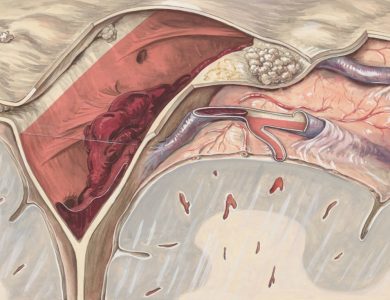
Rarer but dangerous: a slow subdural hematoma or a vertebral/carotid artery dissection can also present as a delayed headache. These are uncommon — but they’re exactly why the red-flag checklist in the next section matters.
Red Flags That Mean Go to the ER Now
If any of the following are happening right now, stop reading and get to an emergency room — by ambulance, not behind the wheel. According to the CDC, traumatic brain injuries cause roughly 190 ER visits per day in the US that weren’t initially recognized as serious, and the window for catching a brain bleed can be measured in hours.
Go to the ER immediately if you have any of these:
- A sudden “thunderclap” headache or what feels like the worst headache of your life
- Vomiting, repeated nausea, or pain that keeps escalating despite acetaminophen or ibuprofen
- Confusion, slurred speech, blurred or double vision, unequal pupils, or trouble staying awake
- Weakness, numbness, or loss of coordination on one side of the body
- Seizure, fainting, or memory gaps about the crash itself or the hours afterward
- Clear fluid or blood draining from the nose or ears, or a visible new neck deformity
Lower your threshold even further if you’re in a higher-risk group: anyone taking blood thinners (warfarin, apixaban, rivaroxaban, clopidogrel, even daily aspirin), anyone over 65, anyone with a prior concussion or brain injury, and anyone with a known bleeding disorder. For these groups, even a mild-seeming headache after head impact warrants same-day imaging — typically a non-contrast CT scan.
If you’re on the fence, call your local nurse line or 911 dispatcher and describe your symptoms. Erring toward evaluation costs you a few hours; missing a slow brain bleed can cost far more.
Symptoms That Warrant a Regular Doctor’s Visit, Not the ER
Most post-crash headaches aren’t 911 situations. The majority of headaches that emerge in the days after a minor or moderate collision are soft-tissue and muscular in origin — uncomfortable, sometimes alarming, but not dangerous. Here’s what falls into the “schedule an appointment” category:
- A mild-to-moderate headache that eases with rest, hydration, and a standard dose of acetaminophen or ibuprofen (avoid NSAIDs in the first 24–48 hours if a concussion is on the table — ask your pharmacist).
- Neck stiffness or shoulder soreness that creeps in 24–72 hours after impact. This is the classic whiplash inflammatory timeline.
- Occasional lightheadedness or fatigue without vision changes, confusion, weakness, or vomiting.
For these low-risk presentations, a 24-hour “watch and see” window is reasonable — but only if you’re keeping a written symptom log. Note the time, intensity (1–10), location, and any triggers. According to guidance echoed by Consumer Reports and major academic medical centers, contemporaneous documentation is the single most useful tool both for your clinician’s diagnosis and for any insurance or injury claim later.
Aim to book a primary care or urgent care visit within 3–7 days. That window protects your health by catching slow-developing issues early, and it protects the paper trail by establishing a clear medical link between the crash and your symptoms.
Which Type of Doctor to See for a Post-Crash Headache
Once you’ve ruled out the ER-level red flags, the question becomes which door to walk through first. Picking the wrong specialist wastes time and can leave gaps in your medical record.
Primary care physician (PCP): Start here in most cases. Your PCP can perform a basic neurological exam, order imaging if warranted, refer you out, and — critically — create a contemporaneous medical record dated within days of the crash. The American College of Physicians considers PCPs the appropriate first stop for non-emergent post-trauma symptoms.
Neurologist: The right call if symptoms persist beyond 2–3 weeks, if you’re experiencing migraine-like patterns you’ve never had before, or if there are any focal signs — numbness, vision changes, balance problems, or memory issues consistent with post-concussion syndrome.
Physiatrist or physical therapist: Best for whiplash, cervicogenic headaches, and myofascial pain. A physiatrist (PM&R doctor) can coordinate a rehab plan; PTs handle the hands-on work.
Chiropractor: Reasonable for mechanical neck pain — but only after imaging has ruled out fracture, ligamentous instability, or disc injury, and ideally one credentialed in post-trauma care. High-velocity cervical manipulation on an unstable spine can cause real harm.
Dentist or TMJ specialist: See one if jaw pain, clicking, or bite changes accompany the headache — common after airbag or seatbelt impact.
What to Expect at the Appointment: Exam, Imaging, and Diagnosis
Walking in knowing the script makes the visit shorter and the findings clearer. Expect the clinician to spend more time touching, watching, and asking than ordering scans.
The neurological exam is the backbone. Expect reflex testing at the knees and elbows, pupil response to light, eye-tracking (smooth pursuit), finger-to-nose coordination, tandem gait (heel-to-toe walking), Romberg balance testing, and a brief cognitive screen — recalling three words, serial 7s, or orientation questions. Neck range of motion and palpation along the cervical spine help separate whiplash and cervicogenic headache from intracranial causes.
Imaging is targeted, not automatic. A non-contrast CT is ordered when there’s suspicion of bleeding, skull fracture, or any red flag from the prior section. MRI is reserved for persistent symptoms beyond 2–4 weeks or suspected soft-tissue and ligamentous injury. Cervical X-rays evaluate alignment and rule out fracture before any manipulation.
For concussion, expect a standardized tool like the SCAT6 or a symptom inventory. Here’s the part most people miss: a normal CT does not rule out concussion. Concussion is a clinical diagnosis based on symptoms and exam — imaging only rules out bleeding.
Documenting Symptoms to Protect Your Health and Any Claim
Insurance adjusters and defense attorneys look for one thing first: gaps. According to the Insurance Research Council, claims with a gap of more than 72 hours between the crash and the first medical visit are significantly more likely to be reduced or denied, because the gap creates room to argue the headache came from something else. That’s true whether or not you ever file a claim — solid records protect your health first and your options second.
A few practical habits make a real difference:
- Keep a daily symptom journal. Note pain level (0–10), location, triggers (screens, light, turning your head), sleep quality, missed work hours, and any brain fog or word-finding trouble.
- Photograph visible injuries as they evolve — seatbelt bruising across the chest, airbag abrasions, swelling — with timestamps. Bruises often look worse on day 3–5 than day 1.
- Tell every provider the symptoms started after the crash. That single sentence belongs in the chart, not just in your head.
- Save discharge papers, imaging reports, prescriptions, and referrals in one folder (a phone photo album works).
Whether to consult an attorney is a personal decision and separate from getting care. The point of documentation is that you have an accurate medical record — what you do with it later is up to you.
How Long the Headache Should Last and When to Worry About Chronic Pain
Most headaches resolve within 1–3 weeks. More specifically, whiplash-related headaches typically resolve within 2–6 weeks, and post-concussive headaches usually fade within 1–3 months. According to the American Academy of Neurology, roughly 80% of concussion patients recover fully within that window with appropriate rest and a graded return to activity.
The trouble starts when symptoms cross the three-month mark. At that point, clinicians may diagnose persistent post-concussive symptoms or chronic post-traumatic headache, a trajectory that affects roughly 10–30% of concussion patients. Risk factors include a history of migraines, prior head injuries, high initial symptom burden, poor sleep, and untreated anxiety or depression after the crash.
Watch for these chronic-trajectory red flags:
- Headaches intensifying instead of plateauing after week two
- New or worsening sleep disruption
- Mood changes, irritability, or difficulty concentrating
- Dizziness or visual symptoms that linger past a month
If you’re stuck, evidence-based options include vestibular and oculomotor therapy, manual therapy for the cervical spine, cognitive behavioral therapy for pain, and medications ranging from NSAIDs to tricyclics, beta-blockers, or CGRP inhibitors for headaches that look migrainous. Most people recover fully, and early documentation, consistent follow-up, and not pushing through symptoms too aggressively are the strongest predictors of getting back to baseline.